43 Folders

43 Folders feed subscription icon - Shiny! New to 43 folders? Here are our All-time Most Popular Posts. Want the best stuff? Here are our Classics.

Login or register

Register for free on 43 Folders to comment on articles, post to our forum, customize your visits, and much more. Current users can login now.

Creative Constraints: Going to Jail to Get Free

A Brief Message: No Resistance Is Futile

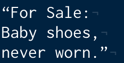
For Sale: Baby Shoes, Never Worn

Paul Ford has been posting six-word Twitter updates for a few weeks, and now he’s also created the magnum opus of six-word criticism: sexological reviews of the 763 mp3s in this year’s SxSW torrent.

Writing on (the 200-words-or-less site) A Brief Message, Paul talks about how the constraint changed his approach and his thinking:

Now when I face a new writing project, I open a spreadsheet. I want a grid to keep track of sources and dates, or to make certain that the timeline of a story makes sense. The grid imposes brevity. Relationships between sentences are exposed. Editing becomes a more explicit act of sorting, shuffling, balancing paragraphs. In this spirit, I’m rewriting some blog software to read directly from Excel. We’ll see how that goes.

Yes. Constraints. As Paul shows, constraints get you thinking about the creative process in a whole new way.

Me? I ♥ constraints. 30 seconds. 5 things. Less than 140 characters.

In fact:

Twitter’s making me a stronger writer. I think harder about how to say more using fewer and shorter words. Nothing beats hitting the Twoosh. (140 chars)


Let’s close with a favorite quote on creative constraint from Anne Lamott’s wonderful Bird by Bird. She explains that she keeps a one-inch-square picture frame on her desk to remind her of “short assignments:”

It reminds me that all I have to do is to write down as much as I can see through a one-inch picture frame. This is all I have to bite off for the time being.

Well put. (And only 17 characters north of the Twoosh.)

The Question to You

Got a good example of a creative constraint at work?


23 Comments

Comment viewing options

Select your preferred way to display the comments and click "Save settings" to activate your changes.
shreddd's picture

tiny lit

along the same lines, i discovered this great little zine (http://www.littleelegy.com) that specializes in “tiny lit” - short stories in 100 words or less.

Joe's picture

Reminds me of a quote

I love quotes (good ones, of course, present wisdom in few words). This one both embodies the sentiment in this post and follows the character limit rule:

“If you can’t write your idea on the back of my calling card, you don’t have a clear idea.” - David Belasco

Mashedspud's picture

I wish

Try telling that to university lecturers, politicians, CEO’s at meetings, wives, children and pretty much anyone else who loves expounding their favorite theirs and the sound of their own voice.

Mashedspud Green lasers rulz

EricLandes's picture

Brian Eno discovered this as well

When he was creating the default sound effects for some version of Windows or other, he was enthralled by the constraints of trying to produce interesting music in sub 10 second bites.

mattlatmatt's picture

Oulipo and writing with constraints

As the other commenters have noted, there are a lot of great examples of how creative folks use constraints to enhance rather than hinder creativity. The mainly French writing group Oulipo takes this writing with constraints thing to outlandish extremes. A famous example is George Perec’s A Void, a 300 page novel that’s written entirely without the letter E. You can look them up on the wikipedia for more info of course, but I would like to point out one quote:

The group defines the term ‘littérature potentielle’ as (rough translation): “the seeking of new structures and patterns which may be used by writers in any way they enjoy”.

What I love about this is the idea of constraints as enjoyable tools.

knackered hackette's picture

Jane Austen's famous line on constraint

JA famously described her novels as: “the little bit (two inches wide) of ivory on which I work with so fine a brush, as produces little effect after much labour.”

Nuff said.

DanielGenser's picture

The idea of external constraints works in all aspects of life.

Constraints on your physical surroundings works wonders also. I once moved from Seattle to Aberdeen, Washington (a depressed logging town on the Washington coast) for this exact reason. I needed to clear some headspace, so I moved to Aberdeen without a vehicle (almost unheard of - this is logger country) and rented a basement apartment. Other events in my life at the time made it not such a good decision, but creatively the results were astounding. I felt so much more free - to write, create, everything. Everything felt new in that new context. I found Seattle (and other cities with large amounts of creative people) creatively stifling.

Since the Aberdeen days, I moved back to Seattle and got married. After a year in the city, my wife and I escaped again - this time to Vashon Island - a little island a 20 minute ferry ride from Seattle and Tacoma in the Puget Sound. Having the physical constraints of a ferry schedule have been great for me. My money, time and attention are now more focused, without all the glittery distraction-filled lights of the city. It’s helped me focus inward and on my marriage and goals.

So the idea of constraints can be used in my contexts.

scameronde's picture

Calvin and Hobbes

a whole universe of whisdom in 3 pictures and a few words.

conniereece's picture

9 lines, 54 characters each

Back in the days of mainframes & line printers, I had to write copy for the donation receipts for a nonprofit. Each week I had to come up with a new way to say thanks in a fixed space: a maximum of 9 lines of 54 characters each. I hated that task at the time, but I realize now that it forced me to be very creative and succinct.

Darrel Girardier's picture

The Tools

For me, if I have a presentation due or some sort of quarterly report I force myself to use the simplest tool I can find. That usually is the app Textedit. It forces me to strip away all the fancy document options and focus on what matters. The message.

Brandon_Leedy's picture

Twooshing is solid for student's wanting to focus...

I’ve used twitter to help constrain thesis sentences, requests, and “short emails” to both professors and friends. Albeit the twoosh was with editing, it really is a great way to help you be more concise. Also for emails the “five sentences” rule (think I saw it here on 43F?) really helped me. Got to be a five sentence ninja!!! Check it out here: http://five.sentenc.es/

Joyride's picture

No mouse

A kind of life-hackerish constraint is to use the computer with only the keyboard, no mouse. I did this on windows many years ago and learned learned a lot about application design and the tab key. Haven’t tried it in OS X yet, but I’m sure it’d be a fun experiment.

communicatrix's picture

Tasty, tasty boundaries

I love…

…forcing myself to hammer out my 750-word acting columns in an hour. Good exercise for me, the wordy procrastinator, and makes me feel better about doing it for such a ridiculously low sum.

…doing speeches at Toastmasters b/c they’re total time nerds. Great practice.

…the audio version of Twitter constraints, Jott. Plus the amazing transcriptions that come back, no matter how slowly I speak into the phone.

…coming up with the sidebar items for my newsletter, my media recos of the month. It’s fun trying to be pithy and persuasive.

I did not much like writing TV and radio commercials, but I have to say, it was great training, learning to write in :30 and :60 (or even :10 and :15) increments.

beloit08's picture

The 12-minute rush

I thrive on time constraints. If I’m bogged at work, I’ll set a time widget for 12 minutes and see how much I can get done in that time. Knowing my time is finite (even if self-imposed) makes me work very efficiently for some reason.

JeremyCherfas's picture

50 x 100 x 50

I infected myself with a desire to write 50 posts of exactly 100 words in 50 (consecutive) days. My source was Blue Girl, and there are a couple of us out here now doing this thing. Nobody is forcing us. I like that.

MrVideo's picture

:15 & :30 sec constraint

I edit video commercials all day. Talk about a creative constraint… If you have to tell the whole story or evoke an action in :15 seconds - that’s a challenge. I am always amazed how effective it can sometimes be, and how often it fails.

With web video, my clients are going back to the days of the Shell Oil and Palm Olive long-form video ads. When airtime is cheep, things tend to go VERY long.

It’s the age-old argument of whether a long form sales pitch is better than a short-form one. The answer? The people who will buy are the people who will read (watch) as much as you give them.

Joe's picture

A trend in the posts

It seems like a lot of posts focus on using time as a creative constraint. I’m not trying to get down on the lot of you, but I thought it relevant to point out that time is a constraint for practically everybody: it is the universal constraint. While I don’t doubt the utility of forcibly increasing the constraint of time to cause efficiency, I do wonder whether the ubiquity of time constraint lessens its ability to boost creativity. After all, we all deal with this issue all of the time.

While Merlin writes “As Paul shows, constraints get you thinking about the creative process in a whole new way”, I’m now wondering whether time, as a constraint, really is a tool for creativity; perhaps it is just a tool for efficiency. Sorry, I was trying to avoid the semantic debate - but there it is: is efficiency a medium for displaying creativity? What new can we glean from dealing with time constraints?

Here’s my revised question for this topic, then: what are the most novel constraints that you use to boost creativity? Which constraints (like writing without the letter “e”) do you do on a whim, for no logical reason at all? These seem (to me) like more useful tools for increasing “creative” output.

communicatrix's picture

If you're going to put the semantic gloves on...

I would argue that at least some of the time-delimited exercises do stimulate creativity.

As I like to twist the Toastmasters credo, “Learning to speak within the allotted time is not just a skill, it’s a way to force your synapses into firing differently when you have 1 minute left to deliver 5 minutes’ worth of speech.”

But I see your point.

Some of my favorite exercises come from Natalie Goldberg and Julia Cameron, both writers who teach creativity. Specifically, I”m thinking of two: Julia’s Morning Pages (or “AM PP”, for the lazy of hand), which is three pages of mental vomiting on the page, first thing in the morning, only stopping allowed for punctuation; and Natalie’s First Thoughts, which is a timed exercise. You pick the time—I like “sprints” or “etudes”, but again, about blasting through blocks. And crazy stuff comes out, trust me.

Both of these are similar in that they remove (or try to) the judging, telling one’s inner critic to STFU. In my own experience, this gets me the most bang-per-buck, creatively speaking. An exercise like writing without “e” would just make me nuts.

It occurs to me that a lot of games are predicated on this construct of taking something away or imposing artificial constraints: you can’t say a particular word (or use any words), or you have to use the last letter of the last word to start the new one, etc. Great improvisers are crazy-creative, for sure.

Personally, I’ve always hated party games, and even improv, except as a rehearsal/creativity tool. I’m very competitive, but have a deathly fear of doing something wrong, so they make me panicky.

But YMMV and chacun a son gout and sh*t.

JeremyCherfas's picture

Turn the screen off

I cannot remember where I first read this advice, but someone suggested that one of the problems of writing in a word processor is that the stuff you’ve just written is sitting there staring you in the face and mocking you, challenging you to tweak that one thought before you have another.

So I sometimes go crazy and turn the monitor off. It can be very pleasantly surprising to turn on again and find that there is even some good stuff there.

I also use WriteRoom for a nice clear distractionless surface, and

beloit08's picture

Time as a constraint

I think it depends on how well you use time. As Communicatrix said, when you have 1 minute to deliver 5 minutes worth of speech, you’re going to get creative. Whether or not it’s internally or externally imposed, a distinct time frame will force a person to do things he might not even have thought possible. That’s the way I use it, and I’ve found it especially helpful with creative projects that don’t seem to be going anywhere. “All right. You’ve got 12 minutes. Go!” Then whatever happens, happens. Often, though, I’m not displeased with the results.

I’m talking here mostly as a writer. As a design professional, I think other constraints work well. Size is a great restraint—canvas size, for example. If you have to paint on 6” * 6” canvases, that’s going to force you to do things. Or let’s say you decide to give yourself a constraint in photography and spend the next week photographing only things that primarily yellow (I’ve done it, with mixed results). These are good constraints for the visual artist. But writing? Be it nonfiction, fiction, or even code—that deadline can do amazing things to the mind.

isaacszy's picture

Web promo copy

When I wrote copy for an online electronics retailer, we had to provide the copy to the Webmasters in Excel spreadsheets with specs like "Between 70-80 characters" or "40 characters with spaces". So we got good at writing things like...

Sound you can Feel.* 180w of power, 5-band EQ and MP3 input jacks let you take your tunes anywhere. $199.95 after rebates.

samgrover's picture

Photography constraints

I constrain my photography as such: One rangefinder camera. One lens, 50mm prime. Black and White 35mm film. No flash. No cropping. Besides photographing socially, I constrain myself to street photography.

Sometimes I use color film. Rarely, I crop. That’s about it.

sidehike's picture

If brevity is the soul of wit, try flirting via text message.

If you can be funny within the constraints of SMS, ladies will find you charming. It’s a proven fact. With that said, they may be disappointed with your non-brief (or briefless, for that matter) encounters.

 
EXPLORE 43Folders THE GOOD STUFF

An Oblique Strategy:
Only a part. Not the whole.


STAY IN THE LOOP:

Subscribe with Google Reader

Subscribe on Netvibes

Add to Technorati Favorites

Subscribe on Pageflakes

Add RSS feed

The Podcast Feed

Inbox Zero

The original 43 Folders series looking at the skills, tools, and attitude needed to empty your email inbox — and then keep it that way. Don’t miss the free video of Merlin’s Inbox Zero presentation.

Get Started with ‘GTD’

David Allen’s popular productivity book and the system on which it’s based help turn ‘stuff’ into actions that support valuable outcomes.