43 Folders

43 Folders feed subscription icon - Shiny!Time, Attention, and Creative Work. After 4 years and a lot of productivity pr0n, we’re shifting gears. Re-learn how to use 43 Folders. Then back to work. [»]

”What’s 43 Folders?”
43Folders.com is Merlin Mann’s website about finding the time and attention to do your best creative work.

Art & GTD

This topic has been incubating in my brain the past few weeks, and I'm getting it to where it can be reasonably put together. It's partially a response to kenzi's thread, GTD and the creative life...possible? (N.B.-I haven't put it into practice yet for fine art, but I can see how it would work in theory since it works so well for design projects.)

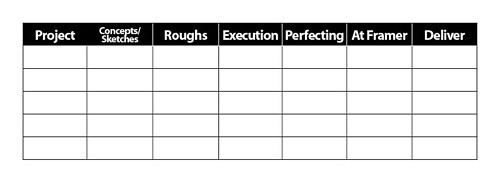
Art isn't always created in a linear fashion, but for the most part I'd say art creation usually follows this general process:

  • Conception/Sketches/Brainstorming
  • Rough/Mock-Up/Preliminary Drawing
  • Execution (the actual Making of the piece)
  • Revisions/Tweaks/Changes/Perfecting
  • Presentation/Finishing (ex: varnish and framing on an oil painting)
  • Delivery of finished piece (ie: taking it to the gallery to be sold!)

It occurs to me that these can be thought of as contexts to hook into GTD. Let's say you've been commissioned to do a painting for someone. You'll follow a process similar to this one, right? So to hook into the GTD ideology, you can move your project ("Painting for Mr. Z") from one context to another, and that will present next actions: "Come up with 5 rough ideas to present to Mr. Z," or "Finish highlights," or "Call framer to get their business hours so I can know when to take the painting there to be framed."

I can imagine a wall of a studio being all or mostly corkboard: post pictures that inspire you, or reference material, or draw a simple chart that lets you move a project from one context/stage to another. There are variations on this that are possible.

I work at a design and marketing firm, and we have a similar chart on our wall on a 4 x 6 foot dry-erase board in our office. It lets us track our projects. The columns, going across, are: JOB# - PROJECT TITLE - FINAL DUE - IN DATE - NEXT REV. DUE - IN HOUSE - TO CLIENT - STATUS - DESIGNER. On the IN HOUSE and TO CLIENT columns, there are colored velcro dots that we place on there so we'll easily know the status of a particular job. The colors correspond to who's working on what project. My projects are blue, so I get blue dots, and everything about the project is written in blue. So you can tell that all the blue rows are mine, and those are the projects I'm working on right now, and (x) of them are in-house and (y) of them are out for client revision.

I think a similar system can work for fine art projects, only without all the approval processes that commercial projects have. (Commissioned art is another story, though.)

###

Now how about the non-project-tracking side of creativity? The part that generates ideas?

One of the problems with fine art is that most of the time, you create your own work. (Of course, you can argue that the work creates itself, but for all practical intents, you are the one who determines what work you will do, rather than a boss telling you what to do.) So I think a good Someday/Maybe system should be in place to store ideas that come to you, a good way to capture those things that come to you. And a good way to archive and index those things, perhaps. Artists have done this for centuries with something called a Morgue, a collection of drawings, photos, found objects that inspire new artworks.

My grandfather used to store photos and images of things he used to paint, sort of a library of images to draw from. Whenever he needed a chicken to go in this picture, he pulled out a file with photos of chickens, and found one that suited his watercolor piece, modifying it as he saw fit.

My morgue is pretty scattered, with all sorts of images tossed into one really fat file. Most of it is stuff I think just looks cool. On my Mac's desktop I keep a folder for tossing images I like into it.

Either method it works. They both provide inspiration for your art work, and are a valuable reference source, and should be treated as such. The thing is that it is a reference source full of potiential inspiration, and should be easily accessible. Whether you catalog things into categories and such is up to you. Some artists make their art by simply cataloging things and grouping them together in an almost neurotic fashion.

So in a nutshell, my attempt at applying GTD to creativity is this: use contexts to move your projects along, and maintain a good Morge and Someday/Maybe file.

And always carry a sketchbook or a camera, so you can capture things on the fly.


Comment viewing options

Select your preferred way to display the comments and click "Save settings" to activate your changes.
pooks's picture

Chrome -- this is a...

Chrome -- this is a terrific expression of how this can work, and I want to delve into it and study it.

The first novel I wrote, I just started writing and writing and things would happen as I was writing and I would be delighted with each new twist and turn and it eventually wound to a big emotional showdown and an ending, a couple of hundred or so pages later. Plot? What's a plot? (It actually had one, but only by luck.)

Since then I've mostly combined that method with plotting like this:

Get a lightning stroke of an idea -- start writing.

When that creative surge is spent -- ten pages later, or five chapters later --

Look around and think, "Okay, what next?" And research and ponder and piddle and curse until suddenly the next lightning stroke, and the next surge.

Until I finish.

This hasn't been totally unsuccessful, but it hasn't been as successful as I'd like, either.

That's when I heard about and bought the book SAVE THE CAT, which breaks down the screenwriting process (or novel-writing, as it turns out) in a similar way to that which you've done.

And I guess the time was finally right, because for the first time I'm forcing myself to complete each step before moving forward. When I thought I'd completed my preliminary plotting (with 3x5s, no less) and started writing, I realized quickly I hadn't spent enough time and had to stop and go back to the outline and keep working on it.

Much like an artist might do some preliminary sketches, I'm having to write a little along the way. There are a couple of scenes that I really need to see and feel -- to hear the character's voice, so I can figure out if she's attacking her daunting problem with grit and fierce determination, or whether she's attacking it with sass and verve. I can't arbitrarily pick one -- I have to write enough of her to let her begin to speak to me, so I can feel her personality. I know she has to be strong, but I don't know how that strength manifests itself.

All that to say, I discovered STC and its linear process for creating at the same time I discovered GTD and the two have been dueling for my time and psychic energy. But they've also fed each other.

And looking at your chart and reading your ideas is very helpful.

Also, the only morgue I've ever heard of has been a newspaper morgue. (Oh yeah, the dead body kind, too, of course.)

But I love that term for snippets of ideas, for stories I started and didn't finish, or researched and didn't start.... I definitely need to set up a morgue instead of what I'm doing now, which is having stuff here and there.

Thanks for such an insightful post!

kenzi's picture

Great breakdown Chrome. I...

Great breakdown Chrome. I think that is a great model to work with.

I don't see any reason that an artist has to be a flake or tortured or any other negative stereotype. Yeah, the planning and organizational stuff can keep you out of your creative groove and tie up your brain in ways that restrict creativity, but I think that GTD actually could help foster creativity by cleaning the brain of all that accumulated daily crap which is what is really mucking up the works. I'm already feeling a shift in my creative process by planning things out in projects and organizing things to get to the actual creation stage. Plotting out NAs for my creative projects has helped the brainstorming process; thinking about the steps makes the project seem more real and doable. Before GTD I kept thinking that these projects were more like "yeah, right! as in never!" rather than "sometime/maybe".

A lot of artists these days are creating not only because of the urge to create but also to sell what they create in order to make a living. This IS business so we have to be good business people (or at least well organized and professional) to make a living doing our art. The alternative is to work some crap job leaving you little time to do the art. I can see that I lose clients by not tracking things well and losing phone numbers and not doing what I said I would do because I can't remember where I wrote it down. Having all that stuff handled by my system will allow me to be more present with my clients.

As for the morgue, it makes me think "this is where design ideas go when they die". But the idea is a good one. I have design idea folders in my A-Z filing system. I have a idea/inspiration file for each creative project and also some more general files, like some font I like but don't ahve a project associated with it. Actually, this was one of reasons I got into GTD, was to manage all this stuff floating around my home and doing no one any good. I really feel that trust in my system to hold all those ideas for me until I am ready to use them.

Chrome47's picture

This weekend I realized that...

This weekend I realized that I didn't say much about the process of creativity itself. In my mind that's where the artist comes up with all his/her ideas by whatever means works and captures them onto paper or film (speaking broadly). I think that would come at the beginning, and to me it's the most important part of the process. Most of what I wrote about was really project management, moving your projects along in the natural course of development, but being aware of where they are, where they're supposed to be, and thinking critically about how to get them where they need to be if they're not there yet. (How's that for a run-on sentence?)

On a different note, a lot of this is informed by my job as a graphic designer, where it's somebody's job to manage projects. (In our case, it's my creative director, since we're a 5-person outfit--2 designers, 1 copywriter, 1 creative director, 1 business director.) I suppose it's a lot more of a struggle for artists and designers going solo, since we'd love to spend our time creating, not billing. (And wasn't Merlin Mann himself a Project Manager before he started 43Folders?)

But I think GTD gives us a good, simple framework for coming up with a strategy to handle the business. It gives you a good way to get a quick overall view of where everything is, when a lot of times we all get bogged down in the "now" and lose sight of the big picture, regardless of what kind of work we're doing.

Every Monday at 9:00, we have a Production Meeting. I like to think of the Weekly Review as sort of my own personal Production Meeting. And like the times the week and projects get hairy, it can be good to have an impromptu 15-minute meeting/review to see where everything is.

sisyphea's picture

creative process

interesting ideas - the workflow you’ve described fits pretty well my creative process for tutorial work and commissions, but not so much my personal work.

My personal art starts off in quite a scattered fashion - an idea from out of nowhere, a bit of text, a poem or image, an interesting face… recorded as a torn bit of paper shoved in the sketchbook, a scribbled note or a thumbnail sketch. Might be forgotten about, might one day coalesce with some other idea and become a ‘serious piece’.

Plenty of good ideas come to naught - in part because total life disarray (too many commitments, dodgy priorities) meant I just didn’t devote enough time to my art. But plenty were just forgotten about in the inky depth of some outdated sketchbook.

I think the GTD system for my art will need to encompass some way of keeping these ideas current - maybe a blog or wiki where I can scan sketches and notes and keep all this stuff tagged and searchable. Rather than locking them into the sequential order of a book, loose paper and categorized files might be better. Give the art historians something to puzzle over?!

Chrome47's picture

I've finally launched a website to address these issues

This idea has been knocking around in my head a long time: to create a website that addresses a lot of these issues regarding art and productivity. Or more accurately, maintaining productivity in a creative environment. We artists are so easily sidetracked. Case in point, I thought of this website at least a year ago, and only this weekend got it finalized. At any rate, go check it out and see what you think: Mysterious Flame

girdhar's picture

Great artical....

Hi, Crome Now all things have become crystal clear to my mind .You really have given the practical definition of the what creativity should be……….thanks a lot crome.

About Chrome47

Chrome47's picture

Bio

Brad Blackman is an artist and graphic designer working in the Nashville, Tennessee area. His paintings portray the geometry and architecture of everyday things that are easily overlooked, things that are ordinary yet beautiful in their austerity, form, and function, such as highway overpasses, turn-of-the-century storefronts, and enormous steel letters from a bygone era. He lives in Nashville with his wife, Hope.

In addition to painting and designing, Brad also runs the website Mysterious Flame, which discusses ways to maintain creative momentum.

 
EXPLORE 43Folders THE GOOD STUFF

An Oblique Strategy:
Not building a wall; making a brick


STAY IN THE LOOP:

Subscribe with Google Reader

Subscribe on Netvibes

Add to Technorati Favorites

Subscribe on Pageflakes

Add RSS feed

The Podcast Feed

Inbox Zero

The original 43 Folders series looking at the skills, tools, and attitude needed to empty your email inbox — and then keep it that way. Don’t miss the free video of Merlin’s Inbox Zero presentation.

Making Time

3-part series on attention management for artists and makers. Read Bad Correspondence, The Job You Think You Have, and One Clear Line.