43 Folders

43 Folders feed subscription icon - Shiny!Time, Attention, and Creative Work. After 4 years and a lot of productivity pr0n, we’re shifting gears. Re-learn how to use 43 Folders. Then back to work. [»]

”What’s 43 Folders?”
43Folders.com is Merlin Mann’s website about finding the time and attention to do your best creative work.

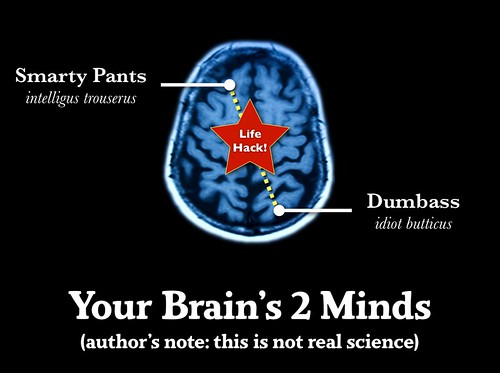
Life hacks: Smarty Pants v. Dumbass

Your Brain's 2 Minds

The New, Soft Paternalism - New York Times

A recent NYT Magazine piece considers the trend toward compulsive gamblers being able to self-ban themselves from casinos and considers the discussions around what this sort of self-imposed “paternalism” might mean.

I don’t have much of an opinion one way or another about whether this is good, bad, paternalistic, or what have you, but I was struck by a couple paragraphs that go straight to the heart of why many folks seek out garden variety “life hacks” in the first place:

You might naïvely imagine that you are one person, the same entity from day to day. To the 18th-century philosopher David Hume, however, the idea of a permanent “I” was a fiction. Our mind, Hume wrote, “is nothing but a bundle or collection of different perceptions, which succeed each other with an inconceivable rapidity, and are in a perpetual flux and movement.” According to this way of thinking, the self that inhabits your body today is only similar to, not identical with, the self that is going to inhabit your body tomorrow. And the self that will inhabit your body decades hence? A virtual stranger…

Further evidence for the fragmented self comes from neuroscience. Brain scans show that the emotional part of the brain, the limbic system, is especially active when the prospect of immediate gratification presents itself. But choice among longer-term options triggers more activity in the “reasoning” part of the brain, located (suitably enough) higher up in the cortex. Now suppose you’re tempted by a diet-violating Twinkie. Which part of your brain — the shortsighted emotional part or the farsighted reasoning part — gets to be the decider? There may be no built-in hierarchy here, just two autonomous brain modules in competition. That is why you might find yourself eating the Twinkie even while knowing it’s bad for you. (A similar disconnect between two parts of your brain occurs when a visual illusion doesn’t go away even after you learn it’s an illusion.)

This is a theme I’ve been thinking about a lot lately; the ways that the “smart” or “correct” or “chaste” part of our mind can potentially help keep the “dumb” or “weak” or “compulsive” part from screwing up; as well as how the dumb part constantly begs help in its way from the smart part, which is then often strangely disinclined to stoop to assistance (“’I’ am too intelligent to need help with such things! Just buck up!”). The smarty quietly polishes his monocle and tsk-tsks while the dummy sits and wonders why he’s such a basket case.


I’ve started to think that many life hacks, like the gambler’s self-ban, represent crude external bridges between these competing factions in our minds. By creating external systems (“put the briefcase in front of the door!”) we provide compensatory mental muscles for the “dumb” part of our minds that is the default boss for so much of our day (or at least my day, anyhow).

Just a theory, but it might help explain something about the ways many of us struggle to always make the right thing the easy thing (I think that’s a Jeff Veen quote), including why we often resist the sort of simple existential heuristics that we’re all too happy to install in children, elderly relatives, or developmentally disabled adults, to name just a few. But us? Me? You? Nah, you and me are way too smart for that kind of crap. Right? Sure.


Of course, as the article notes, the first person who signed up for the casino ban in Michigan also became the first person to be charged with breaking it. It certainly seems to support the notion that the mind who knows what’s best for you ain’t communicating particularly efficiently with the part who doesn’t (even when both know the consequences of letting the dumb-dumb run things). But, more importantly, you learn that in a head-to-head competition with that thin-limbed, monocle-wearing smarty pants, the musclebound dummy often just wins outright.

I like to think that, when applied mindfully, a good life hack can help even the chances for keeping your personal dumbass in line. Or to at least give the smartypants a fighting chance.


Comment viewing options

Select your preferred way to display the comments and click "Save settings" to activate your changes.
Jordan's picture

The Nobel laureate economis Thomas...

The Nobel laureate economis Thomas Schelling wrote about precisely this area in his great book “Choice and Consequence” (specifically the chapter titled “The Intimate Quest for Self-Command”).

PanMan's picture

I had exactly this internal...

I had exactly this internal debate last night over eating a Twinkie, albeit with additional feedback from a third internal contributor observing there were only two Twinkies left, so one of my two daughters would go without one if I ate it. Makes me wonder how to extend the model to “conscience”, who doesn’t care about the fat content, just the fact that someone might be sad.

I ate it anyway, so I guess if nothing else, we know Dumbass can take both SmartyPants and EmotionalGuy…

Vickie Ranz's picture

I've seen a lot of...

I’ve seen a lot of interesting things on 43Folders; however, I think that this one tops many of them for the simple fact that the smartypants in us recognizes that there is a dumb one in the corner who has to basically be led through the nose to get through life fairly competently. The allusion to the muscle bound dumb bunny in your brain versus the slim, trim, stringy armed smartypants rings a clear bellof truth. Why do we need life hacks? Why do we need to define systems that will automatically help us do the next thing the way it should be done (put coat in closet instead of slinging it on the floor upon arrival home, car keys are always parked near the door along with the lunch prepared last night and placed by the car keys so stupid-head won’t forget to take it, etc.)? We need those systems because if we set these systems in place, we don’t give el stupido the opportunity to make an incredibly stupid decision/choice from a myriad of potentially stupid choices. Treat the dummy in the corner as he should be treated with little or no room for freedom of choice/devestation/destruction.

Solo's picture

uhh, disdained... ...

uhh, disdained…

randy gerdes's picture

The writings of Daniel Goleman,...

The writings of Daniel Goleman, particularly “Primal Leadership”, add a lot to the understanding of emotional intelligence (EI), the area of study interested in how the brain processes input and its social and work implications. There is an EI concept called “the six second pause” that’s really interesting The Six Second Pause Inserting the six seconds into your thought process, or routine, can help route the input to the decision part of your brain (this Twinkie will go straight to my b*tt), rather than the more primitive and reactive part of your brain (oooh, cream filling). The theory is you can train your brain and “direct traffic” this way. Lots of implications for managing workflow and for personal effectiveness.

ActivityOwner's picture

To me, this phenomenon is...

To me, this phenomenon is exactly what David Allen is describing in Chapter 35 of “Ready for Anything” — “I sometimes assume that my self-management team is really just one person. But, alas, I’m a committee”.

Toby's picture

Gurdjieff, anyone? ...

Gurdjieff, anyone?

TomL's picture

The problem is far more...

The problem is far more complicated than the prefrontal lobes v. limbic area. Our conscious mental dance is only the top 10% of the iceberg and the rest is submerged in our subconscious, almost completely beyond our control or even our knowing. That makes our lives deep, fascinating mysteries that we can plumb to our dying day.

Solo's picture

The wise side of old...

The wise side of old cultures and religions grasped this fundamental weakness clearly. It is a modern conceit that we can get completely “squeaky clean”. Even the GTD “pron” is a symptom of the power of our lesser selves. How seductive the search for the “Perfect Apostrophe” really is I know quite well.

I also am reminded of Robin Williams’ great turn as the giant headed Man on The Moon who distained his headless body which was running amok on the Moon’s surface. Alas!

But I iron-butt back on the bench, Nixon-like in my determination to make sense of it all with label maker and index cards in hand! We are Sisyphii of GTD! (I combine mine with REBT for REBTGTDlicious self-help.)

Mike-2's picture

One thing that I think...

One thing that I think is missing from this dumbass/smartypants perspective is that the smartypants is the executive part of the brain. It still is the one making a decision, then rationalizing and justifying it. Its not like the dumbass takes control, we’re just in the habit of being reactive to many situations. Meditation is good for taking a direct look at this aspect of your mind and our reactions to simple things like itches and little pains are often the most useful for noticing how little impulse control we have. We let our impulses run wild 90% of the time over the smallest details — how can we expect to tame the mind during the 10% of the day that we think actually matters. That’s the real problem: we want impulse control, but only for important things, and that just doesn’t work. Mindfulness means being conscious and present with our inner dumbass, and that’s how you develop discipline. Its not about supressing your desire for gratification, its about coming face to face with that pain and desire, and then responding to it in a way that’s useful. Sometimes that means staying with the painful sensations until they subside, or it can mean choosing to fulfill the need. I don’t mean pain that can be dangerous — a pain can be as something as simple as the desire to scratch an itch. Try to stay with your desire to have relief from an itch for a moment and notice how crazy your mind gets! Its really shocking how little tolerance we have for even tiny amounts of discomfort. Many people try to bribe their mind by saying, “If you endure this discomfort now, you can get a whole lot of comfort later!” But this is counter-productive, because it trains your mind to believe that comfort, whether now or later, is still the most important thing, and soon you will find your mind filled up with fantasies about future or past comforts, or resenting or fearing past or future discomforts.

Buddhist meditation is like a mind experiment. Notice the constant tumbling and contortions of your inner dumbass, and how desperately it reacts to even the possibility of pain and pleasure. Don’t try to supress it, because that is also a type of reactivity, just stay with the sensations for as long as you can. You will of course get caught up in the reaction and be unable to control it, but that’s ok — as soon as you are able, go back to watching.

One book I am reading right now on this topic is called ‘Turning the Mind into an Ally’, which is good as an introduction, but also has some unique insights that I haven’t seen in other books. And here’s an interview with the author.

About Merlin Mann

Merlin Mann's picture

Bio

Merlin Mann is an independent writer, speaker, and broadcaster. He’s best known for being the guy who started the website you’re reading right now. He lives in San Francisco, does lots of public speaking, and helps make cool things like You Look Nice Today. Also? He looks like this, answers questions, and has something like a life.

Merlin’s favorite thing he’s written recently in the past few years is a short essay entitled, “Better.”

 
EXPLORE 43Folders THE GOOD STUFF

An Oblique Strategy:
Discover the recipes you are using and abandon them


STAY IN THE LOOP:

Subscribe with Google Reader

Subscribe on Netvibes

Add to Technorati Favorites

Subscribe on Pageflakes

Add RSS feed

The Podcast Feed

Inbox Zero

The original 43 Folders series looking at the skills, tools, and attitude needed to empty your email inbox — and then keep it that way. Don’t miss the free video of Merlin’s Inbox Zero presentation.

Making Time

3-part series on attention management for artists and makers. Read Bad Correspondence, The Job You Think You Have, and One Clear Line.