Merlin’s weekly podcast with Dan Benjamin. We talk about creativity, independence, and making things you love.
BooksSample Chapter from "The Creative Habit"Merlin Mann | Dec 1 2008The Creative Habit: Learn It and Use It for Life (Free 1st Chapter) As long as I've outed myself as an obsessive fan of Twyla Tharp's The Creative Habit, it seems sensible to point you to this free excerpt of the book, which includes the full text of the book's first chapter. While it doesn't capture the clear-eyed usefulness of the book nearly as satisfyingly as each subsequent chapter does, it will give you a feel for why this book's different from your garden-variety aspirational artist porn -- this woman does not believe in "natural genius," and she damned well expects you to work your ass off, every day: read more »POSTED IN:
Deciding Whether to Read a Book: Some Wildly Reductive HeuristicsMerlin Mann | Aug 27 2008
On the off chance that you care or find it useful in developing your own filtering, here's my insanely reductive, mean-busy-guy way to make a 90-second decision on whether to read a new non-fiction book from an author I'm not familiar with. It does not matter whether you agree with these; that's how you know they're personal heuristics. Also, they are almost uniformly unfair and unkind. So. read more »POSTED IN:
Free Books for your Amazon KindleMerlin Mann | Jun 6 2008My pick of the week on the latest episode of MacBreak Weekly wasn't so much my new Kindle (which I do like a lot), but rather a few services that make it easier to find and download free books you can read on the Kindle. These picks included Project Gutenberg, Manybooks.net, and the wonderful Feedbooks. read more » 5 Comments
POSTED IN:
Ask MeFi on sane solutions for book clutterMerlin Mann | Dec 27 2007Advice for clearing literary clutter | Ask MetaFilter There's a thread on Ask Metafilter about book-centric clutter that's getting lots of good comments right now. It started when matildaben asked for "practical and creative systems for reducing the number of books I own," saying:
The solutions people offer are thoughtful and suggest that many of the better ideas are coming from fellow bibliophiles who've struggled with The Book Problem. Like several folks in the thread, I think this comment from occhiblu gets to the heart of what makes clutter such an emotionally complex problem: read more » POSTED IN:
The original 43 folders.Ryan Norbauer | Oct 26 2007
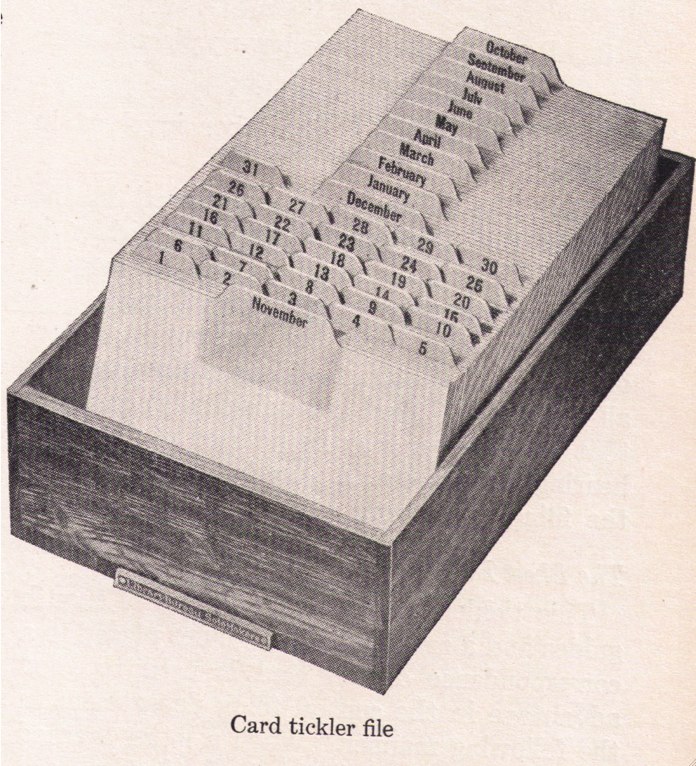
I was recently skimming through my beloved old 1934 edition of Progressive Indexing and Filing, which I inherited at a young age from my grandmother—probably my first piece of productivity porn (the book, not my grandmother.) On page 85, I stumbled across a delightful little gem. Apparently, not only did the David not invent the tickler file (news to me), but it's been around since at least 1934. read more »POSTED IN:
DailyLit: 5-minute literature chunks, via email or RSSMerlin Mann | Aug 1 2007DailyLit: Read books by email and RSS.
To know me today, you'd never imagine how many hundreds of pages a week I read in college. Surprises me, anyhow. While I've devolved into an accomplished skimmer of Harper's and the The New York Times Magazine, I rarely find (or, make) the time to finish a whole book about anything that's not related to "work." That's why I'm intrigued by DailyLit, a service that leverages rather than battles the tendency to hang out online. The idea is simple enough: select a "free" book that appeals to you, then, every day or two, via either email or RSS, the DailyLit robot sends you a section that's readable in about five minutes. If you want more at any time -- the digital equivalent of turning the page -- just click to have the next installment sent, then keep on a'reading. The variety of available selections is handsome, including favorites like Tristram Shandy, The Autobiography of Benjamin Franklin, The Devil's Dictionary and over 400 more. Feeling ambitious? Try War and Peace (675 5-minute parts), The Count of Monte Cristo (581 parts), or Don Quixote (448 parts). Want something a little lighter? You can't go wrong with Candide (42 parts) or A Modest Proposal (4 [still hilarious] parts). read more »POSTED IN:
Guest Review: Fraser Speirs on "Time Management for System Administrators"Merlin Mann | Aug 28 2006Review by Fraser Speirs 
Time Management
for System Administrators by Thomas A.Limoncelli At the end of 2004, Merlin blogged about possible extensions or specialisations of Getting Things Done for specific constituencies, such as programmers, students or parents. Thomas A. Limoncelli’s book Time Management for System Administrators is perhaps the first example I’ve seen of a book which advocates a GTD-style workflow with some modifications specific to the system administration “lifestyle”. Book StructureThe book is laid out under the following thirteen chapter titles:
The core chapters for GTDers to think about are really chapters 4 through 8 and 13. The material about maintaining focus, handling email and managing stress will be familiar to regular readers of 43 Folders. Although Time Management for System Administrators is not a simple modifier on GTD, in the sense that the author doesn’t explicitly reference GTD until the epilogue, much of the structure of Limoncelli’s suggested workflow will be recognisable to those familiar with David Allen’s book. Although Limoncelli doesn’t refer to GTD in the body of his work, it’s hard to avoid certain very obvious parallels such as the analogy of one’s memory as “RAM” (c.f. Allen’s “psychic RAM”) and the strategy of “Delegate, Record or Do” (which sounds much like Allen’s “Do, Defer or Delegate” in another order). However, it would be unfair to dismiss Time Management for System Administrators as a GTD knockoff. It’s certainly not. One area in which I have personally found GTD to be weak is that of helping me decide ‘what to do next’. Certainly, David Allen does have some advice on that matter, but I always found it a little difficult to relate to my workplace. Limoncelli’s Cycle System is, I believe, a very strong contribution to filling that gap in GTD. read more »POSTED IN:
456 Berea Street reviews _GTD_Merlin Mann | Jul 6 2006Getting Things Done (Book review) | 456 Berea Street Roger Johansson at 456 Berea Street has a short review of Getting Things Done that nicely captures the book's tactical practicality and the subsequent stress relief it can bring (which happens to be favorites of mine too): read more »POSTED IN:
Self-help addiction a $8.5B/year businessMerlin Mann | Jun 5 2006I remember thinking a lot of these same thoughts during the self-help mini-bubble of the late 80s/early 90s.
POSTED IN:
|
|




| EXPLORE 43Folders | THE GOOD STUFF |


