Merlin’s weekly podcast with Dan Benjamin. We talk about creativity, independence, and making things you love.
Beginner's Mind, Metropolis, and all our unnecessary parts
Merlin Mann | Jun 28 2005
a million monkeys typing » The Beginner’s Mind
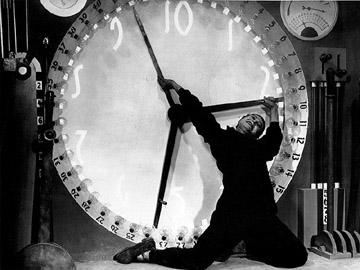
Douglas’s post reminds me of that unintentionally hilarious scene in Metropolis where the Beleaguered Iconic Worker is pushed to exhaustion in the clearly meaningless work of moving the clock hands around on the Big Futuristic Machine he’s charged to attend. ( There have definitely been times in the past couple years when I’ve felt the same way about maintaining “my system”—driven as if by a motor from one list to another, dashing to connect all the pieces into some theoretically unified field theory of my life. It’s nutty. The irony is that I, like many of you, tarry in this productivity sweat shop in order to achieve what David Allen has called “mind like water,” or the ability to adapt to change and disruption in a relaxed manner. So often, of course, the result is the virtual opposite. You get so stressed out about moving the meaningless clock hands on your Big Futuristic Machine that you forget what they’re supposed to be attached to. I acknowledge that a certain amount of Byzantine organizational work is what keeps many of us interested in this stuff, but there is something very compelling about working to adopt Beginner’s Mind—in this case, the idea that you can achieve the higher goals of systems like GTD not by fretting endlessly over the minutiae of your personal ontology, but by exerting the absolute minimum amount of effort needed to get things off your mind and parked in the right place. That’s the sweet spot. Or, to quote Strunk and White, in talking about writing:
Maybe one good goal this week would be to remove the largest, most unnecessary part from each of our machines. It may not be pure “Beginner’s Mind,” but it’s an easy place to start. 15 Comments
POSTED IN:
 As a OCD programmer, I...Submitted by Chris (not verified) on June 29, 2005 - 11:32am.
As a OCD programmer, I too was enamored by the GTD system. The Hipster PDA was great, but it was hard to carry a lot of info. I tried so many different programs and books, but I've come back to a simpler place. Two things helped me see the light:
Here are my simplifications:
With my new Less Is More system, I hope to finally stop gazing at my navel and start getting things done <;) » POSTED IN:
|
|

| EXPLORE 43Folders | THE GOOD STUFF |


