Merlin’s weekly podcast with Dan Benjamin. We talk about creativity, independence, and making things you love.
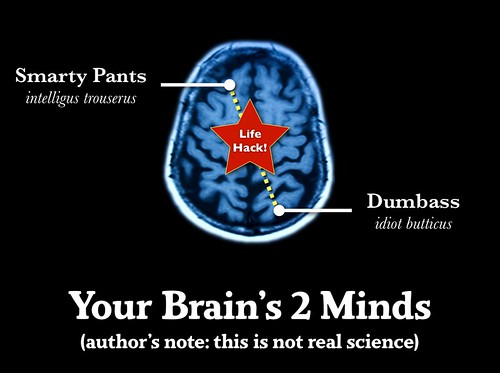
Life hacks: Smarty Pants v. Dumbass
Merlin Mann | Dec 8 2006
The New, Soft Paternalism - New York Times A recent NYT Magazine piece considers the trend toward compulsive gamblers being able to self-ban themselves from casinos and considers the discussions around what this sort of self-imposed "paternalism" might mean. I don't have much of an opinion one way or another about whether this is good, bad, paternalistic, or what have you, but I was struck by a couple paragraphs that go straight to the heart of why many folks seek out garden variety "life hacks" in the first place:
This is a theme I've been thinking about a lot lately; the ways that the "smart" or "correct" or "chaste" part of our mind can potentially help keep the "dumb" or "weak" or "compulsive" part from screwing up; as well as how the dumb part constantly begs help in its way from the smart part, which is then often strangely disinclined to stoop to assistance ("'I' am too intelligent to need help with such things! Just buck up!"). The smarty quietly polishes his monocle and tsk-tsks while the dummy sits and wonders why he's such a basket case. I've started to think that many life hacks, like the gambler's self-ban, represent crude external bridges between these competing factions in our minds. By creating external systems ("put the briefcase in front of the door!") we provide compensatory mental muscles for the "dumb" part of our minds that is the default boss for so much of our day (or at least my day, anyhow). Just a theory, but it might help explain something about the ways many of us struggle to always make the right thing the easy thing (I think that's a Jeff Veen quote), including why we often resist the sort of simple existential heuristics that we're all too happy to install in children, elderly relatives, or developmentally disabled adults, to name just a few. But us? Me? You? Nah, you and me are way too smart for that kind of crap. Right? Sure. Of course, as the article notes, the first person who signed up for the casino ban in Michigan also became the first person to be charged with breaking it. It certainly seems to support the notion that the mind who knows what's best for you ain't communicating particularly efficiently with the part who doesn't (even when both know the consequences of letting the dumb-dumb run things). But, more importantly, you learn that in a head-to-head competition with that thin-limbed, monocle-wearing smarty pants, the musclebound dummy often just wins outright. I like to think that, when applied mindfully, a good life hack can help even the chances for keeping your personal dumbass in line. Or to at least give the smartypants a fighting chance. 34 Comments
POSTED IN:
 A guy wrote a pretty...Submitted by Frank (not verified) on December 8, 2006 - 8:27am.
A guy wrote a pretty interesting essay on this stuff called The Multiple Self:
He goes on to talk about some mumbo jumbo about "command mode" that I'm not really sure about, but I think the first half (or so) of the essay is really insightful. » POSTED IN:
|
|

| EXPLORE 43Folders | THE GOOD STUFF |


