43 Folders

43 Folders feed subscription icon - Shiny! Drowning in email? Try Inbox Zero to learn sane tips for dealing with high-volume email. And don’t miss the free Inbox Zero video. »

”What’s 43 Folders?”
43Folders.com is Merlin Mann’s website about finding the time and attention to do your best creative work.

NYT: Businesses Fight the Email Monster They Helped Create

Lost in E-Mail, Tech Firms Face Self-Made Beast - NYTimes.com

Is Information Overload a Billion Drag on the Economy? - Bits - Technology - New York Times Blog

If you’ve seen the video of my Inbox Zero talk at Google, you may recall the moment when a few attendees start mentioning the hundreds of internal email messages they receive (and send) in a given day. I still remember, because I almost fainted.

Whenever I hear these and similar stories, the same question always comes to mind: “What does a company get out of its employees spending half their day using an email program?” Well, apparently, it’s a question a lot of people are starting to ask. Including Google.

A story in today’s New York Times covers Sili Valley’s new interest in curbing unnecessary interruptions and helping stem the flow of endless data.

Intel and other companies are already experimenting with solutions. Small units at some companies are encouraging workers to check e-mail messages less frequently, to send group messages more judiciously and to avoid letting the drumbeat of digital missives constantly shake up and reorder to-do lists.

A Google software engineer last week introduced E-Mail Addict, an experimental feature for the company’s e-mail service that lets people cut themselves off from their in-boxes for 15 minutes.

A few more stats for you:

A typical information worker who sits at a computer all day turns to his e-mail program more than 50 times and uses instant messaging 77 times…

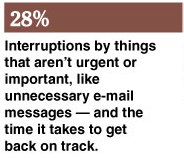
I’d also draw your attention to this infographic illustrating data points from recent studies on “workers’ efficiency at information-intensive businesses.” 28% of a typical worker’s day is spent on:

Interruptions by things that aren’t urgent or important, like unnecessary e-mail messages — and the time it takes to get back on track.

Sidenote: According to that same graphic, 20% of an average day is spent on meetings. Wow. Expressed as a year, that means a meeting you start on New Year’s day would let out around the middle of March. Yikes.

Sounds like these folks have their work cut out for them.


I think it’s important to clarify something here: there’s nothing fundamentally wrong or irreparable about email as a tool. Given my position on how email gets (ab)used, you could be forgiven for thinking I want everyone to write each other letters once a year and ride cows to work. No. Not at all.

My point has always been that, as with any tool, email can be used for good or ill depending on the problems you’ve decided it can solve. One trouble is that our use and widespread adoption of email hasn’t brought with it an equally widely-adopted understanding about how to use it, what content it’s appropriate for, and what expectations we accept regarding when it’s allowed to take us away from everything in our life that’s not email. There are very few shared rules of the road right now. And that’s making life hard for a lot of people.

I’m thrilled to hear that these ideas are bubbling up and getting the attention they deserve; email pain is usually a quiet, lonely, and shameful one, where people’s work and home life suffer from the silent understanding that “too much is never enough” — that trying to tamp down this always-on hysteria is a sign of weakness or sloth. That’s ironic, given the biggest reason we reason use email so much: it’s easy.

There’s no cashier, editor, or therapist through which your message must pass. You set your own rules for what’s appropriate to send, ask, or demand. You decide what it means when someone reacts (or doesn’t react) in a given manner or time frame. Email is still the Wild West, and companies are paying billions of dollars a year to supply the six-shooters and Stetsons. Yeehaw.


I’ll keep following these stories, because, I must tell you, I think it’s going to be a rocky road for businesses to patch. Will whacky experiments like “No Email Fridays” have an affect on how we think about this medium? Only as much as “No Ice Cream Sundays” can help fix your eating disorder.

But, I’m glad they’re trying, and I’m really glad the conversation has started at a higher level.

As for the decision-makers who are struggling with this stuff: these stats are great for getting companies off the bubble, but before you start breaking crockery, I suggest talking to lots of real employees about how they work, how they communicate, and how they might be able to help you.

Every time I speak to a company, I hear half a dozen depressing stories of management disconnection and communication bedlam, alongside one or two completely inspiring tales about how employees and small teams are working to fix things at a squad or platoon level. It’s really amazing, and I wish it were something C-levels and managers were more cognizant of.

So, I suggest you be open to seeing email as just one tool among many, and be gracious about listening to those teams about how they’ve worked to fix or ameliorate these problems.

Bottom line (and I’ll never stop saying this): stop trying to eradicate human communication problems by introducing waves of new technology or made-up rules of social engineering. A company with email problems is also experiencing people problems. Until you understand why the wetware isn’t working like you’d expected, don’t go nuts with top-down technology solutions and over-clever edicts.

There’s a million tiny ways to improve how a business communicates with itself, and a lot of that intelligence is currently trapped, unmined, in the heads of people who’ve never been asked for an opinion. I like to think articles like this represent every knowledge worker’s opportunity to raise his or her hand and say, “Hey, I have an idea.”

[NYT links via Mrs. Mann]


Comment viewing options

Select your preferred way to display the comments and click "Save settings" to activate your changes.
markmiller66's picture

No email days

This is a topic that has been examined for quite a while now. I remember a few years ago there was a story (I believe on NPR) where a company started a no email day. Every friday, you could not use internal email (external email to customers etc. was still allowed). They found after people adapted, they not only managed very well, but they cut down usage the other days too. I’m looking at my email trails today and have several “conversations” that went back and forth with one or two liners several times. A 30 second phone call would have worked better. I guess knowing what is right and doing it are different things.

Merlin Mann's picture

New rug to sweep under

I dunno, Mark. While I wouldn’t discount the usefulness of a trick like “No Email Fridays” for all companies at all times, I’m very skeptical of top-down social engineering whenever it comes to the behavior of knowledge workers.

In particular, I hear, at least anecdotally, that “No Email Friday” often leads to “Twice-the-Email Saturday” or “Wow! Now I’m REALLY behind Monday.”

I think, conceptually, saying “This week, let’s all try to reduce the amount of internal email we send by 15%” is one thing; but, in my observation, you can’t social-engineer your way out of a problem like email overload. You just end up manufacturing a new problem without addressing the root causes of the old one.

I’d love to hear how/whether tactics like No Email Friday have worked for other folks, but I’m not persuaded that history will see this as much more than the “‘Whip Inflation Now’ button” of information overload.

Bill_L_in_Fargo's picture

Ditch the rug.

I agree Merlin that throwing “No Email Fridays” or new technology will not fix the issues created in many of todays business worlds. So, avoiding a “new rug to sweep” under is a good thing, but now what do we use to clean up the mess under these rugs?

I also am curious what has created this monster. Sometimes I worry that the concept of multitasking is to blame. Why should we be working on so many things at once? I think all these things being on the plate bring the constant interruptions.

Thanks for all your insights, Merlin!

kindwarrior's picture

Credit and responsibility

This may be so obvious and taken for granted that no one else has bothered to make this comment:

Back when I was in the industry (when OS 8 was really something Nu) I used to do a lot of management consulting. It started as “added value” for my application development and eventually became the core of my product. I would say 90+% of the management nightmares I stepped into were miss-maps of accountability and responsibility. In your Google seminar one of the employees talked about a support request being sent to a group and people holding back waiting for someone else to answer. That’s a miss-map of accountability. Most people want to take credit for accomplishments while avoiding dangerous “black holes” (for lack of a better metaphor); Most corporate cultures inadvertently or deliberately promote a culture where success is measured by ones ability to pass the buck (batting the ball back across the net). I had a fortune 500 client where I could not hold an effective meeting because the culture had evolved to believe that “Everyone” needed to be invited to every meeting and no felt they had the responsibility to commit to anything. I agree there’s nothing intrinsically wrong with email, but it should be no surprise that the ills of corporate culture manifest themselves there like everywhere else.

jbrougher's picture

Email as written proof

Hi folks!

I try to take a measured approach to email, recognizing its usefulness as well as its faults. That being said, I’m trying to get to Inbox Zero but am also struggling with the fact that email can be a really great way to ensure that communication flows smoothly. To use an example, if there’s a misunderstanding about a deliverable (“do you want 2 of these or 3?”), a saved email can be very helpful. My inclination is usually to delete those emails, which helps clear my mind, but leaves me with no good proof/paper trail later to refer to.

Has anyone else dealt with this issue? Right now, I’m using folders to deal with it, which works to a degree.

so_'s picture

Delete (or archive)

In Merlin’s talk he does want you to empty your inbox, but clearly even on his slides, archiving is an acceptable practice.

Slide 12…. http://www.slideshare.net/merlinmann/inbox-zero-actionbased-email

maines19's picture

Starving on an email diet

Our company instituted what they call the “email diet” one afternoon a week, essentially the same as the no-email Fridays described above. Since much of our work involves team collaboration, being able to send one email and be sure that everyone involved has the same information at the same time just makes sense. How much less productive is it to call or visit six people to convey one piece of info? Meantime, it’s impossible to get any focused work done during the “diet” because people who are abiding by it (initially it was presented as mandatory, with penalties for violation, but that almost started a riot; there’s still pressure from management, though) are constantly sticking their heads in your office to tell you something that doesn’t require immediate action. Whereas if the info is emailed, we can deal with it when we’re done with the task at hand. As one of my group put it, we’d get exactly the same amount done on email diet afternoons if we closed for a few hours.

The proponents of the email diet say that they find the constant barrage of emails distracting; they feel they have to read each one when the little chime sounds. So shut off the chime. Exit the program if you’re too inclined to look at it all the time. Is that really so complicated?

I get a lot of email. As a supervisor, I often get cc’d on all those group emails for the various teams, as well as pretty much anything anybody thinks I might need to know for some reason. It’s a lot. But I triage the box a couple times a day (reading the last email in the thread, for example, to find out the upshot rather than wading through each email), file a lot without reading it because I don’t need the info today but will want it later when I am dealing with that thing, delegate by forwarding with a comment, and in the remainder search on my nickname (what people call me, as opposed to my full first name, which is my email address) in the body for questions or instructions that might be directed specifically to me. (This also separates the people who know me personally from the ones who don’t, which in my job helps prioritize a great deal.) No different than wading through my paper in box, and usually faster because no physical object has to be moved.

This wouldn’t work for everyone, of course, but it works for me. The email diet, OTOH, I find to be a hindrance.

(Ironically, the weekly email diet is announced with a reminder email to everyone in the company. Which gets filtered straight into my trash.)

digitalvision's picture

My problem is in the lack of efficiency

So while I do agree email can be overload, for those who interface with non-tech folks I think email is underutilized.

If there is something that can be quickly answered with one line or two lines (I’ve been staying to the under five sentence suggestion very well), I see no problem with a quick email.

However, many times, non-techs want a thirty minute phone call on something that can be a 30 second email. It’s just not worth the time for all of that. Especially when you work in a technological field and they don’t.

How to bridge the gap of spending literally three or four hours on the phone a day talking about nonsense that could be handled in 20 minutes of email, and then real work can begin?

gleiby's picture

Top-down culture

True that “top-down” will not change company culture, how top management handles their email will set the example for the rest of the company.

Example; People on get a response from their email between 2 and 4 every day from top execs because they are doing work the rest of the day and refused to be interrupted (of course, for this to work, they can not yell at subordinates for not answering email immediately).

BTW, email as a paper trail is key. I have huge (backe up) archive files.

Mashedspud's picture

just a tool

Pure and simply email is just a tool, a means of communication. If too much time is being spent on unproductive communication, you prioritize, streamline and enhance efficiency. The exact same applies to emails.

Mashedspud Green lasers rulz

About Merlin Mann

Merlin Mann's picture

Bio

Merlin Mann is an independent writer, speaker, and broadcaster. He’s best known for being the guy who started the website you’re reading right now. He lives in San Francisco, does lots of public speaking, and helps make cool things like You Look Nice Today. Also? He looks like this, answers questions, and has something like a life.

The best thing Merlin’s ever written is a short essay called, “Better.”

 
EXPLORE 43Folders THE GOOD STUFF

An Oblique Strategy:
Distorting time


STAY IN THE LOOP:

Subscribe with Google Reader

Subscribe on Netvibes

Add to Technorati Favorites

Subscribe on Pageflakes

Add RSS feed

The Podcast Feed

Inbox Zero

The original 43 Folders series looking at the skills, tools, and attitude needed to empty your email inbox — and then keep it that way. Don’t miss the free video of Merlin’s Inbox Zero presentation.

Making Time

3-part series on attention management for artists and makers. Read Bad Correspondence, The Job You Think You Have, and One Clear Line.