43 Folders

43 Folders feed subscription icon - Shiny! New to 43 folders? Here are our All-time Most Popular Posts. Want the best stuff? Here are our Classics.

Login or register

Register for free on 43 Folders to comment on articles, post to our forum, customize your visits, and much more. Current users can login now.

Email Insanity & the 0.001 Challenge

Via a Toot by Jeff Atwood comes this thoughtful post by Tantek Çelik on how email is no longer working for him. His first reason is a biggie:

1. Point to point communications do not scale.

All forms of communication where you have to expend time and energy on communicating with a specific person (anything that has a notion of “To” in the interface that you have to fill in) are doomed to fail at some limit. If you are really good you might be able to respond to dozens (some claim hundreds) of individual emails a day but at some point you will simply be spending all your time writing email rather than actually “working” on any thing in particular (next-actions or projects, e.g. coding, authoring, drawing, enjoying your life etc.)

This is one reason I’m getting attracted to using Get Satisfaction as a way to expose help issues to a large group of helpers and helpees (BTW, we’re just getting started on GS — FAQs and more will be coming soon). I’m also realizing that this is why I (and Jonathan Coulton and probably you) struggle with holding up dozens of one-on-one conversations — it locks up your attention and its fruits in thousands of inaccessible alcoves. And truly, that does not and will not scale.


But, y’know, as I read Tantek’s post, alongside his “Communication Protocols” notes, I found myself returning to a pet theory that I’ve been too embarrassed to lay out in a real post. But what the heck, I’ll capture some notes and you can tell me what you think:

I suspect that email encourages people to act insane.

Right this minute, you can create an email of unlimited length covering topics of unlimited scope and then send it to unlimited numbers of people — whom you may or may not even know — all at absolutely no cost to you. There is also no prohibition or boundary of any kind on how you phrase that email. There’s no formal penalty or even feedback for when you’re using email inappropriately (e.g. the dirty look that you’d get if you said something this weird to someone’s face). Plus, of course, YOU get to decide (at least in your own head) exactly how quickly all those people should be getting back to you about whatever it is you emailed them about. And you can do this pretty much any time you want and as many times a day as it suits you. No Limits.

An optimist would say this indicates what a wonderfully flexible tool email is. But, a pessimist with 1500 unread emails will point out that this Wild West of Communication seems to bring out the nut in people.


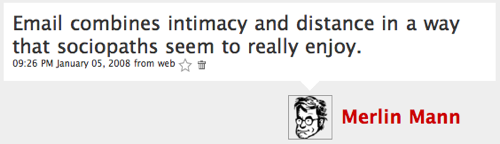
As I say, there must be something about email’s unusual combination of intimacy and distance that can get people very emotionally engaged in hammering out demands in an email message. And not just flames — I’m talking about people whose de facto style is borne out of an uninhibited conduit between thoughts, emotions, or desires and the email medium that helps them convert that into some kind of request.

How and why this is related to Tantek’s post, I’m not entirely sure. But I think there’s some common ground here. Especially as this relates to that one-on-one idea and why it doesn’t scale.

Email culture and etiquette — if there is such a thing — occurs when people have a sense of how their behavior will be seen and evaluated by anyone who is not themselves. The reason most of us wear pants to the grocery store is the same reason that some people think very hard about every word that goes into their email messages and what it will mean when people read them. They understand that the message should be more about the recipient than themselves. And the Great Ones will take the time to get the tone right too — to phrase things so that misunderstandings and unintentional emotional provocations don’t occur.

But if — even without realizing it — you see email primarily as a one-on-one medium for venting some…thing that’s on your mind, you’re going to produce a lot of electronic madness. Especially if you think no one is watching.

I’m going to think on this some more, but I’ll close with a related thought on why this all goes straight back to Time & Attention 101.

Any system without scarcity or limitation will eventually suffer at the hands of people who aren’t overtly aware of boundaries — or who actively choose to break those boundaries because they can. Limitations in a communication medium not only make you think a little harder about what you have to say, they also encourage you to focus on what you and your recipient really need out of the exchange.

While I’m not suggesting anything as extreme as the five-sentence email, I wonder if this might be a fun exercise to try for a day:

The 0.001 Challenge

Imagine that the person receiving the email you’re composing receives 1,000 other message each day more or less identical to yours. What would you do to distinguish yours from the others? What change would make your email amazingly easy to deal with and not insane? Does the content of your email belong someplace else? Like an SMS, a face-to-face meeting — or maybe even in an angry, venting screed that you never send.


23 Comments

Comment viewing options

Select your preferred way to display the comments and click "Save settings" to activate your changes.
jbrougher's picture

Totally agree--mostly.

Merlin, can’t agree with you more. The one thing that I would say, as a minor point, is that having things in writing can be very powerful, and email can be a useful tool in that regard. If your supervisor and you (or your client and you, etc.) have a disagreement, having an old email/letter/piece of paper lying around makes those problems much easier to resolve.

I think people go way overboard on email, but I think that that piece is worth mentioning.

fwade's picture

Agreed!

I couldn’t agree more. I advise anyone who will listen that they need to use email with care, as the rules of engagement via email are changing as we speak.

I would go further and say that no-one should ever use email to try to resolve an upset, communicate disapproval, give feedback and express anything other than the most positive feelings. These should be reversed exclusively for phone or face to face conversations.

Yet… people still try, making a mess of it. To overcome the unique combination of intimacy and distance takes superb writing skills that are only possessed by a handful… and of that number, few have the time one hand that is required to write great emails.

Jonathan Barrett's picture

Feedback

All good points, and I think you’ve hit the nail on the head with the “feedback” idea. Email, SMS, twitter - none of these have tangible automatic feedback to say “message received, read, and will be responded to within (x)”, or “message deleted as inappropriate”. Everyone communicating with you through these channels can think they’re the ONLY one communicating with you, and hence as you say, can invent their own expectations of an appropriate response.

Phonecalls and IM are different - instead of being point-to-point, they’re “face-to-face”. If I call and you don’t pick up, I know that message didn’t get through. If I leave a message, you can tell from my tone of voice how urgent it is. If I try again and get no response, that’s all feedback. Same with IM

Nothing stops me banging 20 emails an hour at you until you respond. I’ve had people do this before, and they genuinely don’t understand why they haven’t had a response yet.

Of course, blog responses also provide no feedback mechanism, and this reply is more about me working this stuff out in my own head than contributing much more than you’ve already said, so I’ll shut up now.

-J

luomat's picture

It's even (especially?) bad in churches

I was talking with a group of 6 other pastors 35 and under about issues/conflicts/etc we had faced in our churches and without any effort on my part, EVERY ONE of their stories involved someone who was using email in some passive aggressive form that they had had to respond to as pastors.

I have had to tell our secretary and the head of our church board to STOP EMAILING EACH OTHER because they both have unfortunate”tone of voice” via email and each one cannot “read” the other person correctly.

My decision to leave my first church was prompted, in part, by “anonymous” email that I was getting through a webform on my personal website telling me I was wasting my time on this web stuff when I should have been spending all of my time on the church (I was only working about 12 hour days).

Funnily enough, the “anonymous” web form did tell me the IP address of the person who sent it, which traceroute’d back to a small company in town where one of my key volunteers worked.

He signed his email “mad@righteous-anger.com” so I setup Apache to automatically redirect connections from his IP address to www.righteous-anger.com (which was, at that time, a website for a hard rock band, IIRC) which led him to send me another anonymous email from a different computer/IP (I assume his home computer) telling me he was going to try to get me fired, which I replied-to at his regular email address, asking if he would like to get together and talk about it (he never did).

It is now my official work policy that if you raise an issue with me via email, I am going to respond on the phone, and I work hard not to give my work email address to anyone who does not need it for what it does well (one way distribution of information). Obviously this won’t work in every job, but I believe that that insanity (or at least rampant passive aggressiveness) email leads to is actively harmful in most churches.

Your idea elsewhere about turning off blog comments (and, I would add, group emails) after midnight would have avoided another messy situation where someone blurted out a rumor that he had heard and CC’d everyone related to the church in his email address book. Fortunately he didn’t use BCC so I knew who I had to go and talk to afterwards, but it took months to fix the damage he did saying something at home late at night all alone that he never would have said in the light of day, or would have said differently.

lammig's picture

Yep, you got it

The worst I think is the email that originated from a BlackBerry/iPhone/Insert-email-attached-to-belt-device-here. Tone, thought, and even capitalization has a tendency to go out the window when its just the thumbs doing the talking.

On the plus side, at least those emails are generally short.

Andre Kibbe's picture

If the focus is on what

If the focus is on what someone needs to know rather than how it’s expressed, email will tend to be short. Without thematic focus, people writing email wind up just interfacing with their own thoughts, and the receipient is subjected to the sender’s inner monologue. Only on rare occasions do I write an email that’s more than five sentences.

It’s pretty obvious when an email is little more a person thinking out loud. As the sender and responder, you have the responsibility to frame the exchage with an emphasis on concision and signal over noise.

Open sentences with delimiting phrases like “The main point is” or “The three issues I want addressed are,” and so on. You’ll find that you receive the short and on-point style of email you send. It becomes the expectation.

kedrhodes's picture

Re: Email Insanity & the 0.001 Challenge

Writing for Business was one of the most useful classes I had in undergrad. I returned to college in my early 20’s to finish up my degree, so I already had a few years of “business” under my belt. After each session of that class, unlike 95% of the others, I left equipped to, if I chose, take immediate action to better my role as an employee, entrepreneur and even husband.

The written word is one of the most beautiful and powerful forms of communication, with thousands of years of rich, shaping influence on who we are as humans. With such a low communication barrier, e-mail makes it easy to forget the influence words have.

“The 0.001 Challenge” is going to change the way we do things here in the office. I’m hopeful it will last for more than a day.

Wisdom: “…or maybe even in an angry, venting screed that you never send.”

Thanks for the great post.

unpeufou2's picture

E-mail can humanize or dehumanize us, or neither

Merlin, I know that you receive exponentially more e-mail than I do, and I’m sure much of it comes from strangers like me. Which of course is the price of celebrity—fanmail is a long-standing phenomenon, as is the expectation of hearing back.

So I suspect that your experience with e-mail as it is today is atypical, especially compared to the Net-connected population at large. Also the experience of IT folks is atypical, as they receive so many requests for a specific type of help.

I think that instead of your language of sanity vs. insanity, I would use the terminology of “humanizing” vs. “dehumanizing,” which is much more common parlance for discussions of the social and psychological ramifications of technologies.

In many ways e-mail, like all mediating (or interface) technologies, has great potential to dehumanize people. The more mediated our contact with one another, the less human our interaction. It’s the same as with driving in a car—if I cut someone off, I can’t apologize to them, or explain how I was confused about the route I was taking. And if someone is driving at me with their fog lights unnecessarily blinding me, I can’t explain to them what’s bothering me. All we can do is gesture and honk and curse. All that glass and metal and noise and velocity between us dehumanizes the interaction.

E-mail can also be totally neutral, as it is when we make choices about how to communicate with people we don’t know or do not see in person. It is our choices about how to write the e-mail that decide if it will be a humanizing or dehumanizing interaction.

E-mail can also be humanizing, when it becomes the subject for discussion between human beings who are in relationship or in community with one another. When I talk with my boss about how we prefer to use e-mail (we like e-mailing notes rather than interrupting each other with minor things), that’s a very humanizing, relationship-building conversation, and the resulting habits also are humanizing because they improve how we work together.

So yes, e-mail can encourage us to act insane (i.e., to dehumanize ourselves and others). It can also be neutral, or it can encourage us to act sanely (i.e, to act more like full-fledged humans). I think the interesting questions ask why this particular technology is sometimes dehumanizing and sometimes humanizing. What makes the difference?

communicatrix's picture

tantek's link not to tantek

As of posting this comment, that link to Tantek’s post links back to 43F.

(I really thought about whether to email this to you or not.)

Merlin Mann's picture

Re: tantek's link not to tantek

Thanks! Fixed!

bradheintz's picture

If only it were one-to-one!

I’m nowhere near as Internet-famous as The Merlin, yet I deal with nearly as much personally-addressed email (not counting newsletters & crap like that).

My problem is that email is NOT one-to-one, and to this post’s cogent list of disadvantages of the medium’s flaws, I’d like to add the CC: field. Whether it’s that special person who thinks his latest 1,000-word rumination on The State of Things is worth everyone’s time and attention, the unending stream of “CYA” CC:s, or the inevitable dozen abuses of “Reply All” that follow, I suspect that my wheat/chaff ratio would triple instantly if we took away CC: and BCC:, limited To: to a maximum of three recipients, and wired “Reply All” to one of those gizmos they use to electrify cattle fences.

It goes right back to your point about making the email about the recipient; CC: can rapidly dilute that quality until it’s about none of the recipients.

ChrisR's picture

Email insanity

I was picking up my daughter from the childminder’s house this afternoon and her computer was playing up. Clearly some trojan was sending out spam messages at a rate of knots and Norton was punching out “message failed” messages at a similar pace. It crashed the machine, but the overwhelming feeling was to laugh. As if sending email at such a rate was somehow not a computer problem, but a sign of self-control gone wrong. Like that crazy person in the street or on the bus, shouting out the names sausages one after the other while everyone tries to ignore it.

The social aspect of email is controlled entirely by individuals. As you say there are no rules. So an intemperate attitude looks very bad indeed, especially since there is no going back. It used to be the case that we thought it was difficult to communicate subtle truths by email. I think the opposite is the case: email style and attitude are highly instructive about people.

librarylass's picture

email list are hotbeds of craziness

I tolerate lists related to my work and put up with the odd vituperative missive because I learn so much in the main, but hobby lists bring out a lot of strange stuff. Maybe its just a women’s hobby list type thing but so many sympathy seekers come out of the woodwork. I’m sure many of them are genuine but I always get an uncomfortable feeling that not all of them are. And of course the list members rally round, things are gathered or made to send to the person, eg, we might be asked to make quilt blocks for someone. At first I got a real nice feeling from doing this, but soon it became a neverending chore, more and more heartwrenching stories would emerge. I don’t know, maybe I’m just cold hearted deep down, I wonder what others think. In another hobby list I got so many snotty emails from the list owner when I offered ideas, I quickly left that one. I also hate to kind souls that pass on joke mail etc. Band wasting, time wasting drivel. fortunately we can all exercise the delete button and save our sanity.

labête's picture

Re: Email Insanity & the 0.001 Challenge

In the closed corporate environment email can be a very useful too to hide behind. By spewing out mail after mail someone can feel productive, they can feel that they have made a difference. When done on a large scale, say 200-300 messages a day this can take up a whole career. I have colleagues who spend their day Outlook or Notes, without ever actually doing anything or seeing anyone.

Since moving companies I have made deliberate efforts to keep myself off the email radar. I now get perhaps 20 emails relating to work, 10 that are filtered off into junk and 40-50 via my various other accounts. i can easily pinpoint the import mails and process them, and I am able to inbox 0 on pretty much a daily basis. Makes a hell of a difference to both my productivity and my sanity.

I love the way email can let me send people things without interrupting them but it is not a good tool for communicating anything more than bare facts, or for ensuring there is a trail of a conversation. I frequently will note the salient points of a conversation and mail it to a colleague, marked as non-urgent (If only this was easier to do in Outlook!). They know it does not require action and can safely file it and it provides some of that much needed accountability and traceability.

Darrel Girardier's picture

Excellent Post

Wow. This is a great post. One I am guilty of a lot. I think I am going to forward this post to everyone in my office. Wait… I think that would the defeat the whole purpose of the post.

priceless's picture

This post is so great I forwarded it...

… to all my friends, all my friends’ co-workers, my friends’ co-workers’ bosses……..

Sorry, couldn’t help it.

This is a really interesting post.

The other part for me is the churn that can occur around someone who posts like that. Especially if they are a “serial cc-er” - you never know WHO is going to be copied on something and where it will go. Invariably a cc to someone’s boss generates hours of debriefing, meetings, etc that that person often isn’t even aware of the impact.

Morgan

PS - i did actually forward a small quote to a friend, only because it was something she’d chuckle over.

beloit08's picture

This got me thinking about email's original purpose

Which was to mimic the traditional business memo (thus the cc fields, etc.) Yet, nearly no one uses it that way any more. I wonder how the medium might change if the “reply” function was optional. Senders could remove the possibility of a reply.

Or, if we remove the reply function all together, then they’d have to find other means to contact a person they wanted to interact with. That might remove some of the anonymity and make people behave a little better.

Anyway, thanks for the post, and thanks for introducing many people to Tantek’s thoughts. good stuff!

Colin's picture

Scaling power and why some people appear insane and others wise

Interesting…

“at some point you will simply be spending all your time writing email rather than actually “working” on any thing in particular (next-actions or projects, e.g. coding, authoring, drawing, enjoying your life etc.)”

  1. Well, not if my job is to get other people to do those things. Most of my “working” time is spent persuading people to do those things I won’t or can’t do. (Eg. Sign that contract with my company.) Email is great for this, or at least moving things toward a meeting or phone call where the deal is completed.

  2. The bias of email toward craziness. Again I’d look at it from the perspective of power. Bizarre random musings, inappropriate commentary and outrageous demands are fine if received from one’s boss but when received from peers or subordinates one is inclined to be less tolerant.

Being ex-army I suppose this appears a little more black and white to me and I’m inclined as well toward a political critique. For example if you CC’ed your whinging email to your CO to the whole camp it might well be the last thing you typed at your current rank. There is a very short and swift feedback loop in military communications and a strong incentive for self-censorship!

semcents's picture

Re: Email Insanity

We need to set up one email with high security, let the provider be responsible for spam. I believe Yahoo and Cisco was working on one of those type of email. Not sure what happened

peadar58's picture

Are we advancing?

This discussion reminds me once again how slow we are to evolve as humans, and how easily we are dazzled by the illusion of speed that technology flashes in front of us. The Megabytes anf MegaHertz multiply but our IQ/EQ remains solidly neolithic! I was really interested in the contrast librarylass made between corporate settings and online “communities” or socialising. Don’t get me wrong some of my tightest “communities” are to be found in my internet life. I also have at least two friends who I would (after seven/eight years of communication) describe as close friends that I have only met with online; although I know it is in my plan to eventually encounter them face to face. But I’ve also seen some very phoney sort of sympathy/emotional fluff buzzing around in online groups. I’m sometimes amazed at how cavalier folk can be with forwarding and CC lists or Reply All. I don’t think we yet fully understand that once we put stuff “out there” it is gone FOREVER from our grasp as people are realising with Facebook and stuff. On balance though I can’t imagine my life without the dimension of the “interWEB” or e-mail. It’s a bit like that Woody Allen joke where the guy reports his family is having trouble with his brother, who thinks he’s a hen. “Why don’t you turn him in?” asks his friend and the answer is “Well, we would, but we need the eggs…”

Plenty of crap out there but most of feel we need the eggs!

mdl's picture

Brilliant!

This is a brilliant insight. A book-worthy insight, if I might add. The foundation of a new communications technology manifesto?

As a university professor, I never cease to be amazed at the tone-deaf emails I receive from students. Just the other day, I got this polite little tidbit, with no salutation:

“Why isn’t yesterday’s PowerPoint presentation on Blackboard!?!?”

Which I’m sure was a well-intentioned request by a student who wanted to review the previous day’s material. However, I couldn’t help but read the message as:

“You lazy idiot! Why don’t you get off your fat ass and put the damn presentation on Blackboard!”

Most people require the limitations of body language, vocal cues, etc. to be polite. We are not socialized to write politely, judiciously—-especially not in an age of instant communication and text messaging.

In fact, most college students today have produced more text than I did at their age (instant messaging, emails, facebook, etc.). But the text they’ve produced has been far less formal and required far less thought than the text that we were required to produce in an unplugged world.

(As an aside, I’ve been watching episodes of Homicide: Life on the Streets—-that classic early 90s series set in Baltimore. I’ve been amazed by two things: 1) how different the unconnected world of the early 90s was; and 2) how much the characters on the show accomplish with notepads, telephone calls, and old-fashioned leg work.)

mdl's picture

Brilliant!

This is a brilliant insight. A book-worthy insight, if I might add. The foundation of a new communications technology manifesto?

As a university professor, I never cease to be amazed at the tone-deaf emails I receive from students. Just the other day, I got this polite little tidbit, with no salutation:

“Why isn’t yesterday’s PowerPoint presentation on Blackboard!?!?”

Which I’m sure was a well-intentioned request by a student who wanted to review the previous day’s material. However, I couldn’t help but read the message as:

“You lazy idiot! Why don’t you get off your fat ass and put the damn presentation on Blackboard!”

Most people require the limitations of body language, vocal cues, etc. to be polite. We are not socialized to write politely, judiciously—-especially not in an age of instant communication and text messaging.

In fact, most college students today have produced more text than I did at their age (instant messaging, emails, facebook, etc.). But the text they’ve produced has been far less formal and required far less thought than the text that we were required to produce in an unplugged world.

(As an aside, I’ve been watching episodes of Homicide: Life on the Streets—-that classic early 90s series set in Baltimore. I’ve been amazed by two things: 1) how different the unconnected world of the early 90s was; and 2) how much the characters on the show accomplish with notepads, telephone calls, and old-fashioned leg work.)

t's picture

How and why this is related to Tantek’s post

Merlin, you asked: “How and why this is related to Tantek’s post, I’m not entirely sure.”

Seems to me that the following that precede this question in your post:

“unlimited length covering topics of unlimited scope and then send it to unlimited numbers of people”

“… hammering out demands in an email message …”

“…uninhibited conduit between thoughts, emotions, or desires and the email medium…”

Appear to be related to the second big point I made:

“2. Emails tend to be bloated with too many details and different topics.”

Your additional point about the apparent emotional obsessiveness (heck, craziness) that this behavior seems to imply certainly feels like an accurate observation to me.

This is an excellent analysis of some existing behaviors, and provides even more reasons to de-emphasize email in collaborative efforts.

-Tantek

 
EXPLORE 43Folders THE GOOD STUFF

An Oblique Strategy:
Only a part. Not the whole.


STAY IN THE LOOP:

Subscribe with Google Reader

Subscribe on Netvibes

Add to Technorati Favorites

Subscribe on Pageflakes

Add RSS feed

The Podcast Feed

Inbox Zero

The original 43 Folders series looking at the skills, tools, and attitude needed to empty your email inbox — and then keep it that way. Don’t miss the free video of Merlin’s Inbox Zero presentation.

Get Started with ‘GTD’

David Allen’s popular productivity book and the system on which it’s based help turn ‘stuff’ into actions that support valuable outcomes.